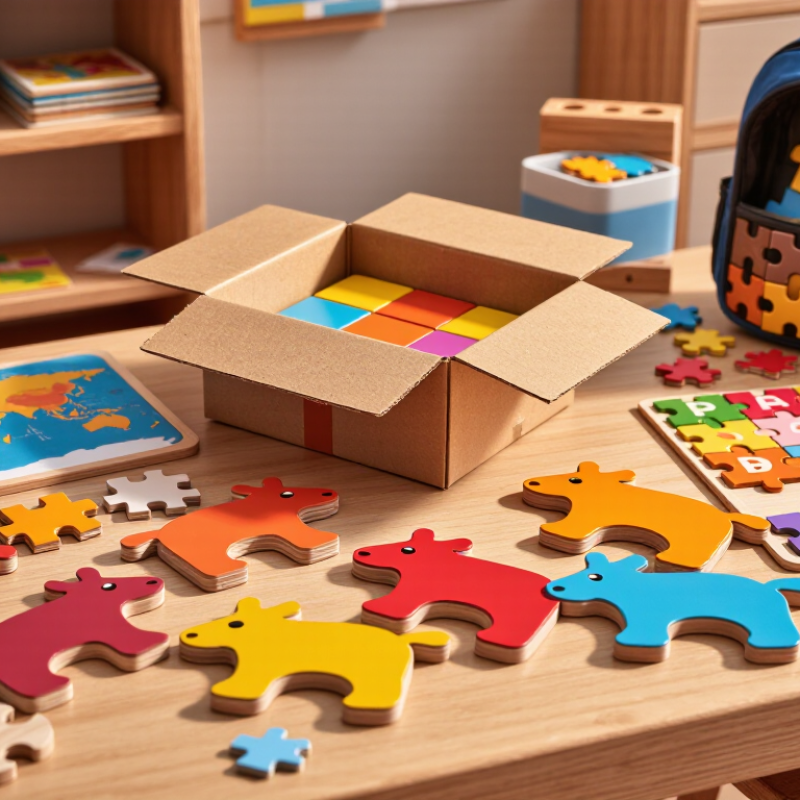
The global toy market is broad, but Kids Puzzle Toys remain a practical category for retailers, educators, and families. Grand View Research estimated the worldwide toys market at approximately USD 108.7 billion in 2023, with continued growth expected through the decade. Yet market size alone cannot identify the best puzzle products. Buyers need evidence about play value, safety, durability, and cultural fit.
Industry data also shows why careful selection matters. Circana’s global toy tracking has reported uneven regional performance, with consumer spending influenced by inflation, household budgets, and seasonal demand. This makes affordable, reusable puzzles especially relevant. A wooden animal puzzle on a classroom shelf, or a compact travel puzzle in a family backpack, can offer repeated use without electronic parts. Small details matter. Smooth edges. Clear colors. Strong packaging.
This guide examines the leading Kids Puzzle Toys through a buyer’s lens. It considers age-appropriate complexity, piece size, educational benefits, material quality, and retail potential. Safety expectations should also be checked against the destination market, including standards such as EN 71, ASTM F963, or applicable consumer-product rules. Supplier documents must be verified, not simply displayed in a sales presentation.
No single industry report answers every purchasing question. That limitation is real. Regional data can be incomplete, and “educational” claims are sometimes too generous. Therefore, this overview combines market research with practical product evaluation. The goal is not to praise every colorful box, but to identify puzzle toys that children can handle, enjoy, and return to repeatedly.
Kids puzzle toys are play materials that ask children to match, arrange, connect, or solve visual problems. Common examples include wooden shape boards, jigsaw puzzles, number games, and three-dimensional construction sets. Each piece gives a clear physical response, such as fitting into a slot or completing an image.
They support hand-eye coordination, spatial thinking, memory, and early problem-solving skills. A child may turn one piece several times before finding the correct position. That small struggle can build patience. It can also cause frustration, especially when the puzzle is too difficult. Buyers should match puzzle complexity with the child’s age and ability, rather than choosing the most advanced design.
Global buyers often select these toys because they are easy to understand across languages and cultures. A picture puzzle may need little written instruction. Compact packaging can also reduce storage and shipping pressure. During sourcing, experienced buyers inspect smooth edges, secure parts, non-toxic materials, readable age guidance, and reliable safety test documents. They also check whether small components create risks for younger children. Some puzzles look attractive but have weak connections or unclear instructions. That detail is easy to miss. Color preferences and learning expectations also differ between markets, so one design may not perform equally well everywhere. A practical review should include sample testing, not only product photographs.
Kids puzzle toys come in several practical forms for global buyers. Wooden inset puzzles use chunky pieces with knobs, helping young children match shapes and practice hand control. Jigsaw puzzles offer larger challenge levels, from six-piece trays to detailed sets for older children. Layered puzzles add depth, such as animal bodies, transport scenes, or simple life cycles. Three-dimensional puzzles build models and introduce spatial thinking. Logic boards, maze puzzles, and pattern blocks suit children who enjoy rules and repeated problem-solving. Floor puzzles create shared play, while magnetic puzzles are useful when magnets are sealed securely.
From my product evaluation experience, age guidance matters more than attractive artwork. Check piece size, rounded edges, surface finish, and clear assembly instructions. Materials should be traceable, durable, and tested against relevant toy safety requirements in the target market. A quiet child may prefer a slow, visual puzzle, while an energetic child may need movement-based pieces. I once underestimated how quickly thin cardboard bends in humid shipping conditions. That mistake changed how I assess packaging and moisture protection. No single puzzle type suits every household.
Tips: Compare difficulty, not just piece count. Examine real product photos for edge quality and loose parts. Ask suppliers about material testing, packaging strength, and recommended ages. For magnetic designs, request safety details and inspect the closure. Leave room for some frustration; a puzzle should challenge children without making play feel impossible.
Puzzle toys do more than fill quiet time. A child rotates a wooden piece, checks the picture, and tries again. This routine builds spatial reasoning, visual discrimination, and early problem-solving skills. Large knobs help younger hands practice grasp and coordination. Interlocking puzzles encourage planning, patience, and flexible thinking. Small pieces matter. They require age-appropriate supervision.
Educators often use puzzles to observe learning, not just completion. Can a child match colors without prompts? Can they explain why a piece belongs in one corner? These moments reveal language growth, memory, and emerging executive function. A thoughtfully designed puzzle also supports persistence. Children experience a manageable challenge, followed by visible progress. The learning feels real because their hands produce the result. However, difficulty can be misjudged. A puzzle that frustrates may teach avoidance instead of resilience.
For global buyers, useful choices include inset puzzles, floor puzzles, pattern boards, and simple logic games. Select clear images, durable materials, smooth edges, and instructions requiring little language. Check age guidance and local safety requirements before purchasing. Inclusive images can help more children feel represented. In practice, the best puzzle is not always the most complex. It is the one a child can explore with modest support. Caregivers may notice children abandoning attractive puzzles when pieces fit too loosely. That small design flaw deserves attention. Rotate puzzle types, sit nearby, and ask open questions instead of solving the problem for them.
Global buyers should treat safety evidence as a buying requirement, not a marketing extra. A puzzle toy should match the destination market’s rules, such as EN 71 in Europe, ASTM F963 in the United States, or ISO 8124 internationally. Ask for recent laboratory reports, not only a compliance logo. The report should identify the exact model, materials, age grade, and tested batch. CPSC’s 2023 toy safety report estimated more than 200,000 toy-related injuries among children under 15 in the United States. Small parts remain a serious concern.
Check the physical product carefully. Look for loose puzzle pieces, sharp edges, weak magnets, peeling coatings, and hidden gaps. Test the box, too. A strong box prevents broken pieces and accidental access during shipping. Chemical testing should cover heavy metals, phthalates, formaldehyde, and restricted dyes where applicable. The European Commission’s Safety Gate 2023 report recorded 3,412 product safety alerts across consumer goods, with toys remaining a frequently reported category. Paperwork can look perfect.
Buyers should also verify factory controls, traceability, and corrective-action records. Request batch numbers, production photos, and retention samples. A supplier that cannot explain a failed test may create future risk. I would not rely on one inspection. Children use toys roughly, and real behavior is unpredictable. Quality checks should include repeated handling, drop testing, and age-appropriate misuse tests. One overlooked edge can matter.
| Product Category | Common Target Age | Typical Puzzle Format | Main Development Value | Key Safety Risks to Check | Recommended Quality Inspection Points | Relevant Compliance Considerations | Buyer Decision Indicator |
|---|---|---|---|---|---|---|---|
| Top Puzzle Toy Categories for Global Buyers | |||||||
| Large-piece floor puzzles | 3–6 years | Thick cardboard or foam-backed pieces, usually 12–48 pieces | Visual matching, spatial awareness, concentration and vocabulary | Small detachable parts, sharp corners, paper delamination and unsafe foam materials | Confirm piece dimensions are suitable for the stated age; inspect edge smoothness, surface adhesion, print durability and resistance to bending | Age grading, migration of certain elements, flammability, mechanical and physical properties, and packaging warnings may apply | Good entry-level choice |
| Wooden peg and knob puzzles | 12 months–3 years | Wooden boards with large knobs, shapes or themed inserts | Fine-motor coordination, shape recognition and hand–eye coordination | Loose knobs, accessible magnets, wood splinters, pinching points and coatings containing restricted substances | Pull-test attached parts; check rounded edges, secure fasteners, smooth surfaces, non-toxic coatings and moisture resistance | Small-part, mechanical-safety, coating and chemical requirements are especially important for products intended for children under 3 | High supervision priority |
| Jigsaw puzzles | 5 years and above | Cardboard, wood or plastic pieces, commonly 50–1,000+ pieces | Problem-solving, patience, visual discrimination and planning | Pieces that are too small for the stated age, paper dust, sharp edges, inaccurate piece count and weak board construction | Verify piece count, dimensional accuracy, image registration, cut quality, color consistency and resistance to repeated assembly | Age suitability, physical safety, material restrictions, labeling and traceability requirements may apply in the destination market | Best for skill progression |
| 3D construction puzzles | 6 years and above | Interlocking board, plastic or molded pieces forming buildings, animals or objects | Spatial reasoning, sequencing, engineering concepts and persistence | Sharp connectors, unstable structures, small parts, excessive force requirements and breakage during assembly | Test repeated assembly cycles, connector strength, structural stability, piece fit, instruction clarity and removal force | Mechanical and physical safety, accessibility of small parts, age warnings and packaging performance should be assessed | Suitable for older children |
| Magnetic puzzles and tiles | 3 years and above, depending on design | Magnetic dress-up sets, pattern boards or magnetic construction pieces | Pattern recognition, creativity, spatial planning and fine-motor skills | High-powered magnets becoming detached or swallowed; broken housings and inaccessible magnet components | Perform magnet retention and impact testing; inspect welds, rivets, housings and warning labels; maintain batch traceability | Magnet-specific requirements can be strict. Ingestion of multiple high-powered magnets can cause serious internal injury | Requires enhanced testing |
| Inset and matching puzzles | 18 months–4 years | Boards with recessed spaces for animals, vehicles, letters, numbers or geometric shapes | Classification, vocabulary, recognition and early cognitive development | Loose pieces, thin edges, finger entrapment, inaccessible fasteners and choking hazards | Check piece size, board thickness, handle attachment, fit tolerance, burrs, splinters and resistance to saliva and perspiration | Products for children under 36 months need particular attention to small-part and foreseeable-use requirements | Strong preschool format |
| Logic, maze and brain-teaser puzzles | 6 years and above | Sliding pieces, labyrinths, sequencing challenges or multi-step logic tasks | Reasoning, memory, planning, attention and independent learning | Pinch points, inaccessible internal parts, frustration caused by unclear instructions and breakage under repeated use | Assess moving-part durability, smooth operation, solution accuracy, instruction readability and resistance to unauthorized opening | Mechanical safety, age grading, durability, labeling and chemical requirements should be reviewed for the target market | Good educational value |
| Safety and Quality Standards Buyers Should Check | |||||||
| United States | All children’s puzzle toys marketed to the United States | Safety testing, labeling and product certification framework | Controls physical, mechanical, chemical, flammability and tracking-related risks | Choking hazards, accessible magnets, lead and other restricted substances, flammability and inadequate warnings | Request applicable third-party laboratory reports, children’s product certification documentation, test samples and production traceability | ASTM F963 is the primary mandatory toy safety standard referenced by federal requirements; the Consumer Product Safety Improvement Act and related regulations also apply | Confirm market-specific certification |
| European Union | All toys placed on the EU market | Conformity assessment, technical documentation and safety labeling | Addresses mechanical, physical, chemical, electrical, hygiene and flammability risks | Restricted chemicals, small parts, misleading age grading, sharp edges and insufficient warnings | Verify CE marking, Declaration of Conformity, technical file, risk assessment, batch identification and test reports | Directive 2009/48/EC and harmonized EN 71 standards are widely used for current compliance; buyers should also monitor the transition to the EU Toy Safety Regulation | CE documentation required |
| United Kingdom | All toys supplied in Great Britain; separate arrangements may apply in Northern Ireland | Product safety assessment, technical records and market labeling | Controls physical, chemical, flammability and labeling risks | Choking, sharp edges, restricted substances, inaccurate instructions and missing importer information | Check the applicable conformity marking, Declaration of Conformity, technical documentation, English instructions and traceability details | UK toy safety requirements are generally supported by designated versions of EN 71; marking and market-entry rules depend on the specific UK jurisdiction | Check GB and NI separately |
| Canada | Children’s toys sold in Canada | Consumer product safety and hazard prevention requirements | Addresses mechanical, chemical, flammability, packaging and labeling hazards | Small parts, accessible magnets, toxic coatings, sharp points and inadequate bilingual information | Review laboratory evidence, bilingual safety information, material declarations, packaging warnings and traceability records | The Canada Consumer Product Safety Act and the Toys Regulations, SOR/2011-17, are key requirements for children’s toys | Review bilingual labeling |
| Australia and New Zealand | Children’s puzzles and toys supplied in either market | Mandatory toy safety and consumer product requirements | Focuses on mechanical and physical safety, small parts, packaging and age suitability | Choking, sharp points, unstable structures, detachable components and misleading age claims | Confirm testing against the applicable AS/NZS toy safety requirements and check local warning and labeling rules | AS/NZS ISO 8124 series is commonly used for toy safety assessment; mandatory requirements can vary by product type and jurisdiction | Validate local obligations |
| Chemical and material quality | All markets | Material declarations and restricted-substance testing | Reduces risks from coatings, plastics, inks, adhesives, wood treatments and metals | Lead, certain phthalates, heavy metals, formaldehyde, prohibited dyes and unsafe plasticizers | Obtain bills of materials, supplier declarations, migration or content test reports, coating specifications and change-control records | Requirements differ by destination. EU REACH restrictions, market-specific chemical limits and toy-specific migration limits may apply | Require current test evidence |
| Packaging and labeling | All markets | Retail packaging, instructions, warnings and identification marks | Helps users select suitable products and use them safely | Plastic-bag suffocation risk, unreadable warnings, missing age grading, incomplete importer details and incorrect translations | Check age range, hazard statements, assembly instructions, disposal information, lot or batch code and language requirements | Warnings must be visible, legible, durable and appropriate for the destination market; packaging itself may be subject to separate rules | Inspect final retail pack |
| Factory quality control | All production batches | Incoming inspection, in-process checks and final random inspection | Maintains consistency between approved samples and mass production | Color variation, missing pieces, weak joints, incorrect artwork, contamination and mixed-age packaging | Use approved golden samples, piece-count verification, AQL-based inspection, function testing, carton checks and corrective-action records | Testing a prototype alone does not guarantee production conformity; significant material or design changes may require reassessment | Audit before shipment |

Buyer note: Applicable requirements depend on the destination country, product design, materials, intended age range and sales channel. A valid test report should identify the exact product, model or batch, applicable test methods, laboratory details, test date and result. Always compare the final production sample and packaging with the documents before shipment.
Global buyers comparing kids’ puzzle toy suppliers need more than attractive catalogs. Grand View Research estimates the global educational toys market will continue expanding through 2030, with customization and learning value supporting demand. However, suppliers often use “educational” too loosely. Ask for piece-count specifications, material certificates, age grading, and product testing records.
Build a landed-cost comparison sheet. Include unit price, sample fees, mold or cutting-tool charges, packaging, inspection, freight, and import duties. A factory offering a low FOB price may become expensive after custom boxes and ocean delivery. Request quotations at several volumes, such as 1,000, 5,000, and 20,000 units. Also check defect allowances and replacement policies. The cheapest offer is rarely the safest choice.
Customization should be measured, not promised. Compare artwork revisions, prototype timing, minimum order quantities, board thickness, puzzle finish, and carton dimensions. Suppliers should identify compliance routes for target markets, including ASTM F963 requirements in the United States and EN 71 requirements in Europe. The U.S. Consumer Product Safety Commission continues emphasizing third-party testing for children’s products. Ask who pays for retesting after a material change. Small details matter.
Test a physical sample.
A practical scorecard can rate quality, communication, lead time, documentation, and total cost. I would not trust polished photos alone; colors may hide weak printing, and prototype quality can exceed mass production. Independent inspection adds cost, but it exposes uneven cuts, loose pieces, and damaged corners before shipment. Some sourcing assumptions will still be wrong. That is why buyers should keep written evidence, approve a sealed reference sample, and review supplier performance after every order.