
Kiteboarding kites are not interchangeable pieces of fabric; they are carefully engineered wings that must suit wind strength, rider weight, skill, and local water conditions. For buyers comparing China’s manufacturers and suppliers, small details matter. Line strength, canopy materials, stitching, bladder valves, and spare-part availability can shape performance long after the first test ride. Small details matter.
Industry figures require careful reading. Grand View Research’s kitesurfing-equipment market analysis offers commercial market estimates, while World Sailing’s Formula Kite coverage around the Paris 2024 Olympic Games documents the sport’s growing visibility. These sources measure different things. Neither provides a complete, independently audited count of global kite sales, so precise market-size claims should be treated cautiously. That caveat matters.
Kiteboarding champion Robby Naish is a useful expert reference for the sport’s equipment culture. Rather than inventing a verbatim quotation, this guide reflects a practical principle associated with experienced riders: choose equipment for the conditions and the person using it. A kite that looks impressive in a catalogue may feel demanding in gusty wind. A beginner may value predictable handling more than aggressive lift. Those trade-offs are easy to overlook.
This guide introduces China’s leading kiteboarding kite manufacturers and suppliers, comparing product range, customization, quality controls, and communication. Supplier claims deserve questions, not assumptions. Ask for material specifications, inspection records, warranty terms, and clear sample-testing arrangements before placing an order. The right choice is rarely the loudest promise; it is the supplier whose details hold up under scrutiny.
China’s kiteboarding kite manufacturing industry draws strength from a broad technical-textile supply chain. UNIDO’s International Yearbook of Industrial Statistics 2024 places China’s share of global manufacturing value added at about 31% in 2022. That figure is not kite-specific, but it helps explain the depth of local capacity for fabric processing, precision stitching, and component sourcing. A kite’s curved panels, reinforced seams, and bridle points demand consistent tolerances. Small errors can change how it flies.
Production quality depends on more than sewing speed. Factories must control fabric alignment, seam strength, bladder sealing, and final inflation checks. These steps are especially important for lightweight canopies, where a rough edge or uneven tension may become visible on the water. Trade databases do not consistently separate kiteboarding kites from other sporting goods, so export totals can overstate or understate this niche. That is a real data gap. Buyers can assess suppliers more reliably through documented material specifications, batch inspection records, and repeatable load tests. Samples should also be checked after packing and transport, not only on the factory floor.
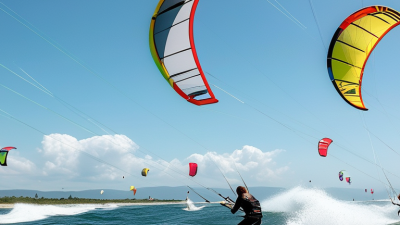
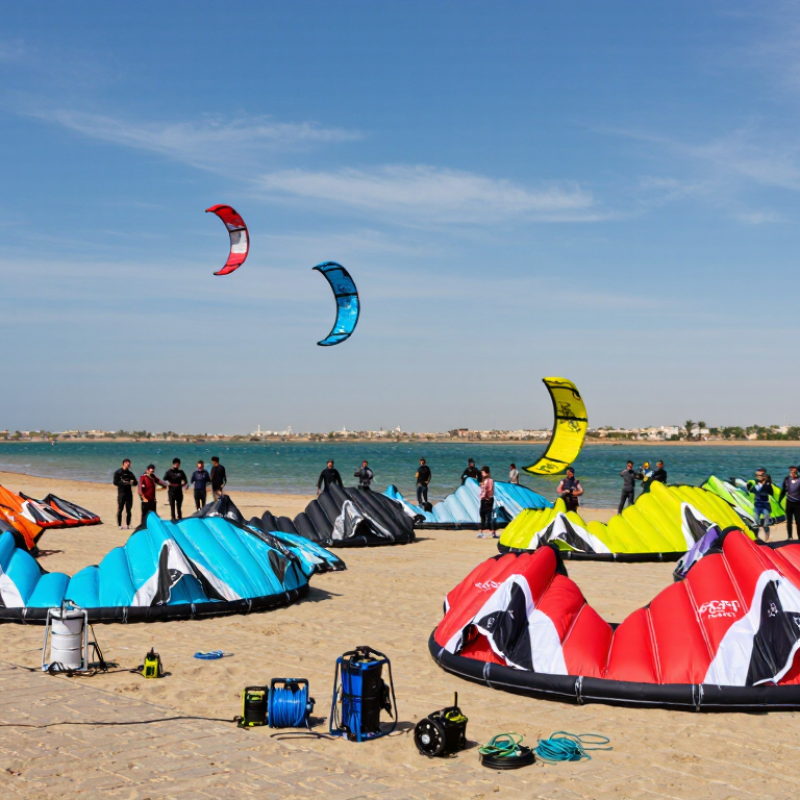
Kiteboarding kites made in China come in several designs, each suited to different water and wind conditions. Inflatable leading-edge kites are common for recreational riding. Their air-filled front tube and struts help the kite keep its shape after a fall. Three-strut layouts often aim for a lighter feel, while five-strut designs can offer firmer support in stronger wind. The trade-off depends on canopy shape and construction, not strut count alone.
Foil kites use fabric cells instead of an inflatable frame. They can pack down small and feel efficient in steady wind, but water relaunch may be more demanding. Within both styles, designers adjust aspect ratio, tips, bridles, and canopy tension to influence turning speed, lift, and stability. Factories may produce different sizes and configurations, but specifications vary by model. Details matter. Stitching, reinforced load points, valves, and line attachments deserve careful inspection; a tidy finish is not proof of on-water durability.
Tips: Match kite size to rider weight, board, and local wind range. Ask for measured wind guidance and clear care instructions. Inspect seams and valves before riding. A design that feels powerful on paper may feel tiring in gusts, so test cautiously when possible. I would not assume one shape suits every session.
China Top Kiteboarding Kites Manufacturers and Suppliers
Kite production begins with material checks. Technicians inspect canopy fabric for coating defects, uneven color, and inconsistent weight. Panels are cut to digital patterns, then aligned carefully to limit distortion. A few millimeters can affect how the kite holds its shape. Small flaws matter.
During assembly, operators sew panel seams, reinforce load points, and attach bridles and leading-edge components. Supervisors check stitch spacing and reinforcement placement against the production specification. Inflatable sections are fitted with bladders and valves, then inflated to reveal leaks or twisting. The process is repeatable, but handwork still matters.
Quality testing combines measurements with practical checks. Factories may inspect line attachment points, seam strength, valve sealing, and canopy symmetry. Sample kites can undergo controlled pull tests and outdoor flight trials in suitable wind. Results should be recorded by model and production batch, not just remembered. A smooth flight is useful evidence, but it cannot replace documented checks. Test methods and limits vary among suppliers, so buyers should ask for inspection records and clarify what each test covers. A kite may pass in the workshop yet behave differently after repeated use. That gap deserves attention.
| Production Stage | Materials or Equipment | Manufacturing Activity | Typical Quality Check | Why It Matters |
|---|---|---|---|---|
| Design and pattern development | CAD pattern software, design specifications, prototype materials | Designers define the kite’s size, panel layout, reinforcement locations, bridle geometry, and intended use before producing cutting patterns. | Review pattern dimensions, panel alignment, and design revisions against the approved product specification. | Accurate patterns help the finished canopy form the intended shape and keep production repeatable. |
| Incoming material inspection | Coated woven canopy fabric, bladder film, webbing, lines, valves, and sewing thread | Materials are checked on arrival and identified by type, batch, and relevant supplier documentation. | Inspect for visible damage, contamination, coating defects, labeling errors, and conformity to the purchasing specification. | Material variation can affect durability, weight, air retention, and consistency between production batches. |
| Canopy fabric cutting | Fabric spread tables, cutting templates, and manual or automated cutting equipment | Fabric panels are cut according to the approved patterns, with attention to orientation and efficient material layout. | Check panel outlines, cut edges, panel identification, and matching of pieces to the production plan. | Consistent panel dimensions support accurate assembly and reduce unwanted distortion. |
| Canopy panel assembly | Industrial sewing machines, compatible thread, and seam reinforcement materials | Cut panels are joined using specified seam constructions. Reinforcements may be added in high-load areas such as attachment points and leading-edge connections. | Inspect seam alignment, stitch consistency, skipped stitches, loose threads, and reinforcement placement against the design specification. | Seams and reinforcement transfer aerodynamic and handling loads through the canopy structure. |
| Leading edge and strut construction | Durable kite fabric, shaped sleeves, bladder compartments, and reinforcement patches | The leading edge and inflatable struts are sewn into the kite layout, with openings and attachment points positioned for their intended components. | Check sleeve dimensions, seam quality, opening locations, and alignment with the canopy and design drawings. | These structures help the kite maintain its shape when inflated and provide support to the canopy. |
| Bladder and valve preparation | Flexible airtight bladder film, valves, valve adhesive or joining materials, and inflation fittings | Bladders are formed or prepared to fit the leading edge and strut compartments, and compatible valves are installed. | Inspect valve attachment, bladder surfaces, joints, and fit; perform leak checks using the manufacturer’s defined procedure. | A sound bladder and valve system helps the inflatable frame retain pressure during use. |
| Bridle and attachment assembly | Low-stretch lines, webbing, connector loops, and line-measuring fixtures | Bridle segments and canopy attachment points are assembled to the specified geometry and length. | Compare line lengths, connection positions, and assembly orientation with the approved measurement sheet; inspect stitching and hardware. | Bridle geometry influences kite control, load distribution, and stability. |
| Final assembly and inflation | Completed canopy, bladders, valves, bridle components, and inflation equipment | The kite is assembled and inflated so that the shape, component fit, and overall construction can be assessed. | Check for visible asymmetry, twisting, wrinkles caused by assembly issues, loose connections, and air leakage under the defined inspection procedure. | Inflation can reveal fit or assembly problems that are difficult to identify when the kite is laid flat. |
| Load and functional testing | Test fixtures, calibrated measuring equipment, and product-specific test procedures | Representative samples or specified production units may undergo controlled checks of structural connections and functional operation. | Evaluate results against the product’s documented test plan and acceptance criteria; record the sample, method, and outcome. | Documented testing helps verify that construction and components meet the intended design requirements. |
| Final inspection and packing | Inspection checklist, repair materials, protective packaging, and product documentation | Finished kites are checked, folded, packed, and matched with the required accessories and instructions. | Confirm appearance, cleanliness, component completeness, identification labels, and packaging requirements before release. | A final check helps prevent visible defects, missing parts, or packaging errors from reaching the customer. |
Leading kiteboarding kite manufacturers and suppliers do more than cut canopy panels. They help buyers verify fabric weight, coating consistency, seam strength, bridle measurements, and line-stretch tolerances. Small variations matter: an uneven seam or mismatched bridle can change how a kite feels in gusty wind. Ask for pre-production samples, batch inspection records, repair materials, and clear lead-time updates. Useful service is specific. “Quality checked” alone is not.
Material claims also deserve careful checking. Textile Exchange’s 2024 Materials Market Report estimated global fiber production at 124 million tonnes in 2023, with recycled fibers accounting for 7.7%. This is broad textile data, not kite-specific evidence, so it cannot prove a kite’s durability or environmental impact. Suppliers should identify the fabric composition and provide relevant test documents instead of relying on vague claims. Discuss minimum order quantities, replacement parts, and packaging before confirming a production run. I would still request another sample after any major design change; that step can feel slow, but skipping it may cost more later. Good service includes honest limits.
When evaluating Chinese kiteboarding kite suppliers, ask how they control quality between samples and full production runs. Request a sample made with the same fabric, thread, valves, and construction methods intended for your order. Inspect the canopy in bright light for uneven stitching, loose threads, and inconsistent panel tension. Small details matter. Ask how the supplier checks inflation, air retention, and bridle-line lengths before packing.
A factory visit or live video walkthrough can reveal practical details: cutting tables, sewing stations, repair areas, and finished-goods storage. Request recent inspection records and clear descriptions of defect limits. Ask who performs each check and what happens when a kite fails. A certificate alone does not prove that every batch meets your requirements. Compare written specifications with the physical sample, including fabric weight, seam reinforcement, and valve placement. Keep notes; vague answers deserve follow-up.
Test samples in controlled conditions before committing to a large order. Check inflation stability, steering response, and wear around high-stress seams, then document findings with photos. Ask about material traceability, replacement parts, packaging, and lead-time changes. Communication is part of quality control. If a supplier cannot explain a delay or revise a specification clearly, that uncertainty matters. Even a careful review has limits; one good sample may not represent every production run.