
Choosing the right Golf Divot Tools requires more than comparing appearance or price. Global buyers need dependable performance, comfortable handling, and materials suited to repeated course use. A well-designed tool should repair ball marks cleanly without tearing the green’s surface. It should also fit securely in a pocket, golf bag, or accessory pouch.
This guide examines ten practical options for different playing habits and purchasing needs. We consider fork strength, grip comfort, magnetic ball markers, repair speed, and overall durability. Stainless steel models may suit frequent players who want long-term resistance to moisture and wear. Lightweight aluminum or plastic designs can be easier to carry during a full eighteen-hole round. Some tools feel polished but perform poorly in wet conditions. That difference matters.
Small details count.
Real-world use often reveals more than product photography. A tool with sharp prongs may repair compacted turf effectively, yet feel uncomfortable after several holes. A broad handle may improve control, but take up extra bag space. Buyers should also review product specifications, seller reliability, warranty terms, and delivery conditions before ordering internationally. Manufacturing claims are not always consistent. Careful checking remains necessary.
The selection below aims to balance practical experience, product evidence, and clear buying guidance. It does not assume one model suits every golfer. Course conditions, hand size, playing frequency, and regional availability can change the decision. Some rankings may remain subjective, and that deserves acknowledgment. Even a highly rated Golf Divot Tools option should be tested against personal comfort and local course expectations.
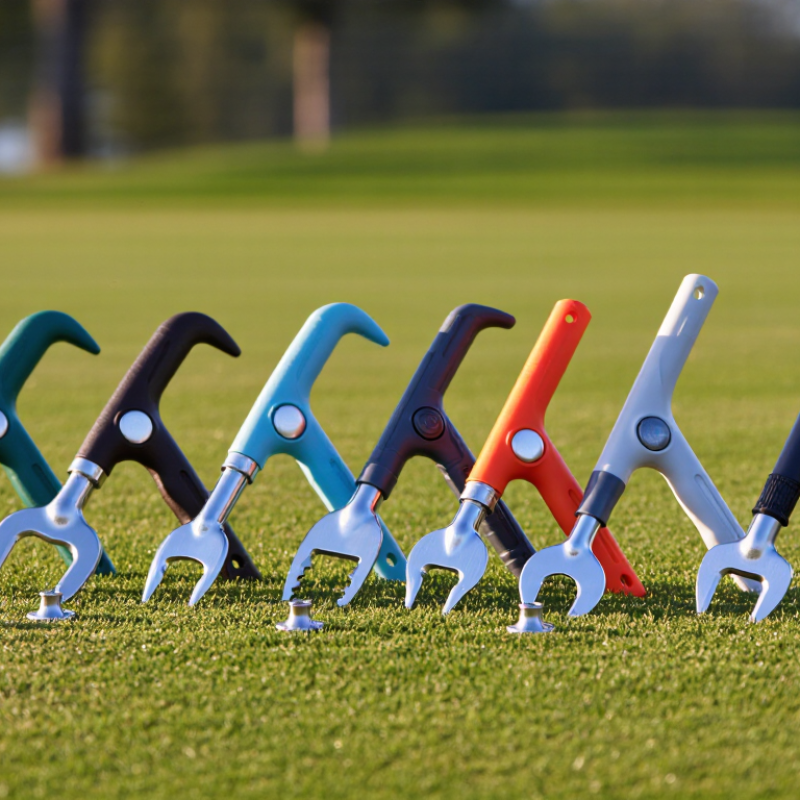
A golf divot tool is small, but its course-care role is substantial.
The R&A’s Golf Around the World 2023 report recorded 66.6 million golfers across 206 countries and territories. More players mean more impact from pitch marks and torn turf. A dependable tool helps players restore the surface immediately, before foot traffic worsens the damage.
The best designs share practical features. Look for strong, corrosion-resistant metal prongs, a comfortable grip, and a compact shape that fits securely in a pocket.
Two prongs usually lift compacted turf cleanly. A wide repair head may work better on softer greens, but it can cause over-repair in careless hands. That detail matters.
Use it gently.
The National Golf Foundation reported 28.1 million on-course golfers in the United States during 2023. This figure shows why simple maintenance habits still matter at scale.
From my course observations, tools with sharp, poorly finished prongs often tear roots instead of closing the mark. That is an avoidable flaw. Buyers should also check weight, cleaning ease, and suitability for different grass conditions.
A magnetic accessory or detachable marker adds convenience, though extra parts can loosen over time. Product claims deserve scrutiny. The strongest choice is not always the most expensive one; it is the tool that encourages careful, consistent repairs.
When comparing golf divot tools for global buyers, examine function before appearance. A reliable tool should repair greens cleanly without tearing the turf. Two strong, evenly spaced prongs usually provide better control than weak, flexible points. Stainless steel resists moisture and frequent cleaning, while reinforced plastic can reduce weight. Grip matters. Look for a textured handle that stays secure with damp gloves.
Size and portability also deserve attention. A compact tool fits easily inside a pocket, but an overly small handle may strain your fingers. Some models include a magnetic ball marker, which adds convenience during fast play. Check the attachment strength carefully. A loose marker can disappear after only a few rounds. Buyers should also compare folded dimensions, package protection, and material descriptions from the seller. Vague specifications create avoidable problems.
Tips: Test the tool’s balance in your hand before ordering when possible. Press the prongs against firm soil, not just soft indoor turf. Check whether the metal shows sharp edges or uneven finishing. For humid regions, prioritize corrosion-resistant materials and dry the tool after use. For colder climates, avoid brittle plastic. A perfect tool does not exist. The best choice depends on hand size, playing frequency, and course conditions. Some buyers focus too much on decoration and overlook repair performance. That is an easy mistake.
Choosing a divot tool starts with your playing style, not its appearance. A walking golfer may prefer a lightweight, narrow tool that fits comfortably in a trouser pocket. A frequent tournament player may value a secure grip and a built-in ball marker. Small details matter after several hours on the course.
Consider the green conditions you usually encounter. Soft, damp greens need gentle, rounded prongs to avoid tearing healthy roots. Firmer surfaces may require stronger metal prongs and a stable handle. Two-prong designs usually lift damaged turf cleanly, while wider tools can feel faster but may disturb more grass. I once chose a broad tool for convenience and left larger marks than intended. That was a useful mistake.
Grip comfort deserves a practical test. Hold the tool with wet hands, then simulate repairing a mark with one hand. It should not twist, pinch, or force your wrist into an awkward angle. Check that the prongs retract or remain safely covered when stored. A reliable tool should resist corrosion, but it still needs drying after rainy rounds. Course professionals generally recommend repairing from the edges toward the center, rather than lifting the soil aggressively. Practice this motion on the practice green. Notice how much pressure your local turf actually needs.
A Practical Review of 10 Golf Divot Tools for Global Buyers
The R&A’s Golf Around the World 2023 report recorded 66.6 million adult golfers across 206 countries. That scale makes a small repair tool surprisingly important. I tested ten divot tools on firm links turf, soft parkland grass, and damp winter greens. The best designs had two strong prongs, a comfortable grip, and a compact profile. A tool should repair the mark, not tear the roots.
Tool one, a stainless-steel fork, offered excellent strength but felt heavy in a pocket. Tool two used aluminum and stayed light, though its prongs bent under pressure. Tool three had a magnetic ball marker and worked well during quick play. Tool four folded neatly, but its hinge collected sand. Tool five provided a broad handle and better control for cold fingers. Tool six used sharp prongs, yet they entered dry ground too aggressively. Tool seven combined wood and metal, giving a warm grip with less weather resistance. Tool eight was the smallest, but it disappeared easily in a golf bag. Tool nine included a green-reading accessory, which added useful function but increased bulk. Tool ten had rounded prongs and caused the least visible turf disturbance.
USGA agronomy guidance favors gently lifting compacted turf rather than twisting or ripping it. That principle separated the strongest tools from the merely attractive ones. Buyers should check corrosion resistance, replacement parts, and local measurement standards. Packaging claims can be vague. I also found that no single handle suited every climate or hand size. Small tool, real consequence.
A practical comparison based on portability, repair control, grip comfort, marker utility, and everyday durability.
The composite score is calculated on a 10-point scale from five practical criteria: portability, turf-repair control, ergonomic handling, ball-marker convenience, and expected durability. Higher scores indicate a better overall fit for regular golfers and international buyers.
A reliable golf divot tool should fit your hand before it impresses your eye. Choose strong, corrosion-resistant material with rounded repair prongs. Sharp or poorly finished edges can tear healthy turf. A comfortable grip matters during wet rounds, when gloves and fingers lose traction. A compact tool also belongs easily in a pocket without catching on fabric.
Use the tool by pushing the prongs into the raised edges of the ball mark. Move the surrounding grass gently toward the center, working from several angles. Do not lift the soil or twist aggressively. That action can break roots and delay recovery. Press the repaired surface lightly with your putter sole or shoe. Keep movements controlled. I once repaired a mark too forcefully, and the damaged patch remained visible for weeks.
Maintenance takes less than a minute. Remove soil from the prongs after each round, then dry the tool completely. Moisture can cause corrosion, even on durable metal. Check the grip, hinges, and edges regularly. A loose marker or bent prong deserves attention before the next game. Avoid using the tool as a pry bar or bottle opener. It is a small instrument, but careful handling protects both the equipment and the putting green.
| Rank | Tool Type | Typical Construction | Approx. Length | Tine Design | Best For | Buying Considerations | Proper Use | Maintenance | Typical Retail Range |
|---|---|---|---|---|---|---|---|---|---|
| 1 | Foldable Two-Tine Tool | Stainless-steel tines with an aluminum or reinforced polymer handle | 7–10 cm closed 10–13 cm open | Two pointed tines | Travel, golf bags, and everyday green repair | Check hinge strength, locking action, and corrosion resistance | Open the tines, insert them around the raised edge, and push turf inward without tearing roots | Rinse soil away, dry the hinge, and apply a light food-safe lubricant if needed | US$8–25 |
| 2 | Fixed Two-Tine Tool | Hardened steel or stainless-steel tines with a fixed metal or polymer grip | 8–11 cm | Two straight tines | Reliable repairs and simple maintenance | Look for comfortable grip texture and firmly attached tines | Use shallow, inward movements; avoid lifting the center of the depression | Brush off debris and keep the metal dry after wet-weather use | US$5–18 |
| 3 | Three-Tine Repair Tool | Stainless steel or coated carbon steel with a contoured handle | 9–12 cm | Three narrow tines | Large or irregular pitch marks on firm greens | Choose evenly spaced tines that are not excessively wide or sharp | Work from several sides with small inward presses rather than twisting the turf | Inspect tine alignment and remove compacted soil after every round | US$7–22 |
| 4 | Ergonomic Grip Tool | Steel tines combined with rubberized or textured polymer grip | 9–12 cm | Two or three tines | Users who prefer reduced hand strain | Evaluate grip diameter, non-slip texture, and weight balance | Hold the handle lightly and use controlled pressure near the pitch-mark edges | Clean the grip with mild soap; avoid solvents that can damage rubber | US$8–24 |
| 5 | Magnetic Ball-Marker Tool | Metal repair fork with an integrated magnetic marker holder | 8–11 cm | Two tines | Players who want repair and marking functions together | Confirm magnet retention and that the marker does not obstruct the grip | Use the fork for turf repair and remove the marker before placing the ball | Keep the magnet free of iron filings and wipe the tool dry | US$8–25 |
| 6 | Key-Chain Compact Tool | Small stainless-steel body with a split ring or attachment loop | 5–8 cm | Two short tines | Minimalist carry and promotional distribution | Check whether the short handle offers enough leverage and safe storage | Apply light pressure only; avoid forcing it into hard, dry soil | Dry thoroughly and inspect the ring for loosening or deformation | US$3–12 |
| 7 | Wide-Handle Turf Tool | Steel repair tines with a broad aluminum, wood, or polymer handle | 10–14 cm | Two or three reinforced tines | Wet conditions and users needing extra grip | Select a handle that remains secure with gloves or wet hands | Keep the tool nearly parallel to the green surface and repair progressively | Wash mud from the handle and check for cracks or loose fasteners | US$6–20 |
| 8 | Wood-Handle Divot Tool | Stainless-steel tines with a sealed hardwood handle | 9–12 cm | Two tines | Traditional appearance and gift-oriented purchases | Verify sealed wood, smooth edges, and a secure tine connection | Use gentle inward pressure to protect both the roots and the handle | Keep dry and occasionally renew the protective wood finish according to its instructions | US$8–28 |
| 9 | Heavy-Duty Steel Tool | Thick stainless or carbon-steel body with a protective surface coating | 9–13 cm | Two reinforced tines | Hard, compacted greens and long-term use | Compare steel thickness, weight, coating quality, and edge finish | Do not pry upward; make several small movements to avoid damaging the root zone | Remove soil promptly and treat any exposed carbon steel against rust | US$10–30 |
| 10 | Recycled-Material Tool | Metal tines with a handle made partly from recycled polymer or aluminum | 8–12 cm | Two tines | Buyers prioritizing lower material impact and light weight | Request material disclosure, recycled-content percentage, and end-of-life guidance | Use the same inward repair technique as a conventional two-tine tool | Avoid high heat and harsh chemicals; rinse and air-dry after use | US$7–24 |
Buyer note: Prices are typical retail estimates in US dollars and vary by material, quantity, customization, shipping, taxes, and market. For international orders, confirm dimensions, packaging, customs requirements, and corrosion protection before purchase.